
What another winter of waiting actually costs
Here's the argument settler: a garage door built before the mid-1990s almost certainly doesn't meet the entrapment-protection standard that's been required on new equipment since 1993. That's not a scare tactic, it's a timeline. If your door or opener predates that standard and nobody has retrofitted it since, you're not looking at a "someday" project. You're looking at a door that can close on a car bumper, a trash can, or worse, without reversing. Add in a McHenry County winter, cold steel, road salt tracked in on tires, ice forming on tracks, and the parts most likely to fail are the ones doing the heaviest lifting: springs and cables. One more freeze-thaw season on hardware that's already fatigued is how a routine repair turns into an emergency call on a Saturday night in January. The fix now is usually a few hundred dollars. The fix after something snaps or someone gets hurt is a different conversation entirely.
The one retrofit that isn't optional
If your opener doesn't have a photo-eye sensor, two small boxes mounted near the floor on either side of the track, it was likely built before auto-reverse and entrapment sensors became standard. This is the single most important thing to retrofit on an older door, full stop.
- What it does: stops the door and reverses it if something breaks the sensor beam while closing.
- Why it matters here: kids, pets, and grandkids visiting from out of town don't know your door is older tech. Neither does a stray cat.
- What it costs to fix: a compatible opener upgrade is usually in the low-to-mid hundreds, and it's a straightforward swap, not a full door replacement.
This one isn't a style preference or a nice-to-have. If this is missing, it goes to the top of the list regardless of what else gets decided.
Springs and cables: what cold weather does to old steel
Torsion and extension springs are rated for a number of open-close cycles, often in the 10,000 range for standard residential springs, and a door from the 1990s has likely used up most of that life expectancy already. Cold makes steel more brittle, and the freeze-thaw cycle that hits this part of Illinois every winter accelerates wear on anything metal that flexes daily.
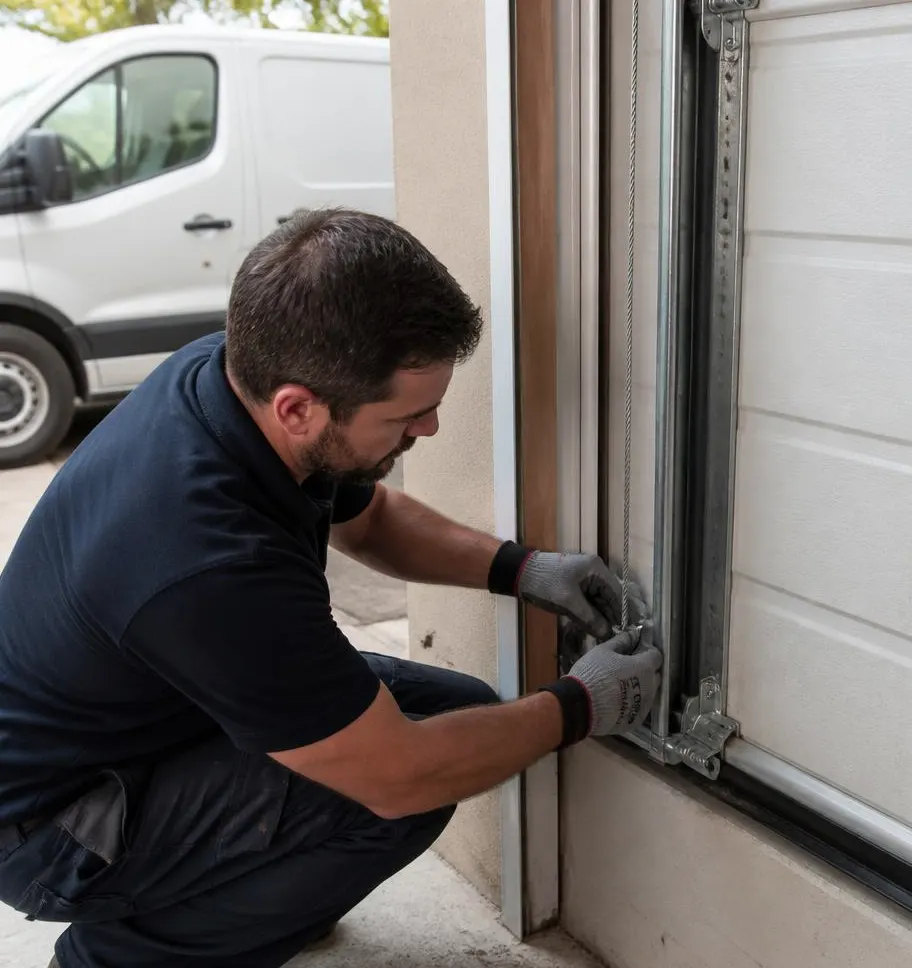
- Extension springs without a safety cable running through them are a real retrofit priority. If one lets go without a cable to contain it, it becomes a projectile. This was common on older installs and is cheap insurance to add.
- Cables showing fraying, rust, or kinks near the bottom bracket are a sign of salt exposure and age, not cosmetic wear. Replace them before they replace themselves at a bad moment.
- A spring that's original to the house and never been serviced is closer to failure than people think. If it's making a popping or grinding noise when the door moves, that's not quirky, that's a warning.
Why this matters more in spring
Spring storm season brings sudden temperature swings and wind loading on the door panel itself. A door that's already straining against fatigued springs has less margin to handle a gust pushing against it while it's mid-cycle.
The quiet stuff you can actually leave alone
Not everything original needs to go, and this is usually where the other half of the argument has a point.
- Solid wood panel doors that aren't rotted, cracked, or warped can be maintained rather than replaced. Sand, reseal, and check hinges for rust; that's often enough for several more years.
- Non-insulated steel doors are a comfort and energy issue, not a safety one. If the garage isn't heated living space, there's no urgency to upgrade for insulation alone.
- Decorative hardware, handles, and non-structural trim don't need touching if they're not cracked or loose.
- A working opener motor doesn't need full replacement just because it's old, as long as the safety sensor retrofit above has been done and the auto-reverse function actually works when tested.
One thing worth checking either way: manual slide-bolt locks on older doors. If someone locks the bolt and then hits the opener remote out of habit, it can bend the track or strip the opener gear. It's a cheap habit to break, not a part that needs replacing.
When to call Marengo Garage Door
If you're not sure whether your springs have a safety cable, whether your opener has working photo-eyes, or your cables look rusted but you're not sure how bad, that's exactly the kind of walkthrough worth having done before winter rather than during it. Marengo Garage Door handles spring repair and replacement and garage door opener services for homes throughout Marengo, Union, Woodstock, Harvard, Huntley, Crystal Lake, Belvidere, and Hampshire, and can tell you plainly what's a safety retrofit, what's cosmetic, and what can wait another year without guessing or upselling a full replacement you don't need.
If your garage door is from the 1990s or earlier and you want a straight answer on what needs fixing before the cold sets in, call Marengo Garage Door, the garage door company in Marengo, IL homeowners trust to tell them the truth about their door.